EV Maintenance & Career Opportunities
EV Maintenance & Career Paths
The EV transition is creating new career opportunities across maintenance, installation, and fleet management — many directly relevant to AMPS and Fort Mojave.
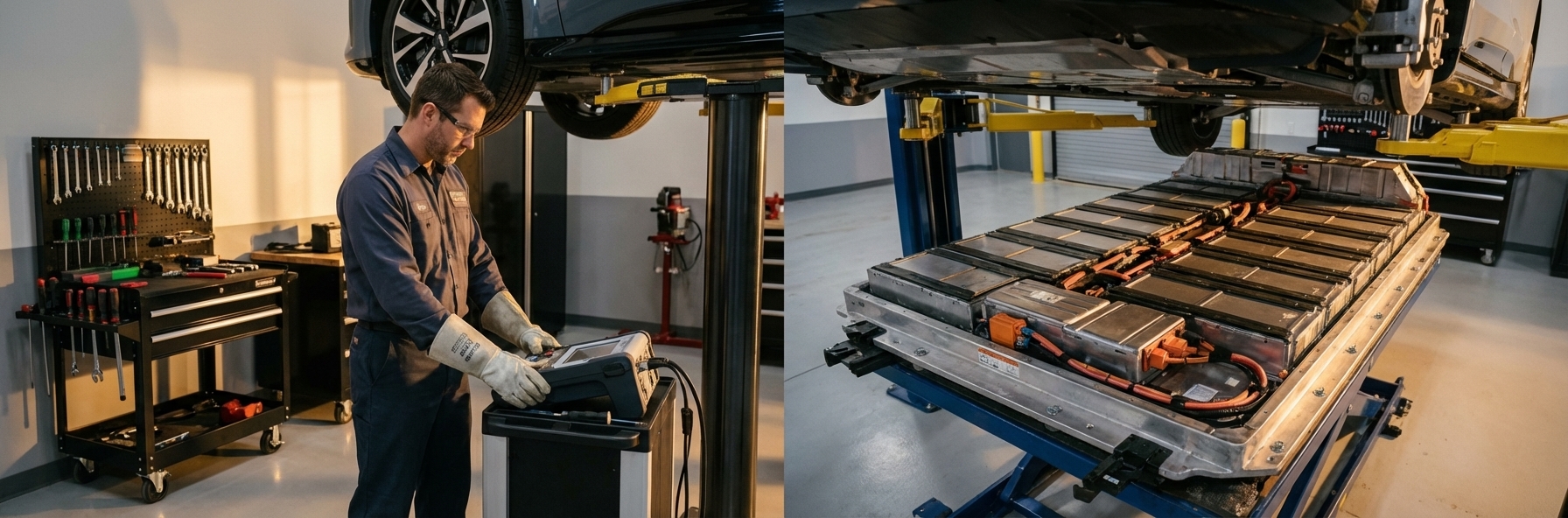
Maintenance Differences
- Fewer moving parts: No internal combustion engine, transmission, exhaust system, timing belt, or spark plugs. EVs have fewer wear components than any ICE vehicle.
- Brake longevity: Regenerative braking reduces brake pad and rotor wear by 30–70% (AAA and Consumer Reports data). Brake fluid still requires annual inspection; pads and rotors may only need replacement every 7–10+ years in heavy regen-use fleets.
- Fluid services: No oil changes. Coolant (battery thermal management loop) checks every 5–7 years. Brake fluid annual inspection. Windshield washer fluid as needed.
- Battery health: Monitor state of health (SoH) via fleet telematics. Most EV batteries lose 1–2% capacity per year under normal conditions. Thermal management and avoiding frequent 100% charging slow degradation.
Career Opportunities — With AMPS-Specific Pathways
- EVSE Installer / EVITP-Certified Electrician: The primary credential is EVITP certification ($275, evitp.org). AMPS electricians with CA licenses can enroll immediately. Contact AMPS for information about exam fee assistance for tribal members. Salary: $55K–$85K/year depending on experience and location; union IBEW electricians with EVITP earn at the higher end.
- EVSE Field Service Technician / Reliability Technician: Troubleshooting and maintaining charging stations in the field — diagnosing faults, replacing hardware, managing network connectivity. Entry-level: $45K–$65K/year; experienced field service engineer: $80K–$110K/year. SmarterHelp (smarterhelp.org) — the workforce training company that spun off from ChargerHelp! in August 2025 — offers EVSE reliability technician training programs for workforce boards and employers. AMPS should inquire about a program licensing agreement.
- Fleet Operations Manager: Managing EV fleet dispatch, telematics, and charging schedules. Increasingly valuable as tribal fleets electrify under ARV-25-015 and similar grants. Salary: $55K–$80K/year at tribal utilities and government fleet operations.
- EV Technician: Vehicle diagnosis and repair. Manufacturer certification programs (Tesla, GM, Ford) layer on top of baseline EV knowledge. San Bernardino Valley College has a ZEV technician program near Fort Mojave. Salary: $50K–$75K/year.
- Clean Energy Project Manager: Overseeing solar, storage, and EV charging projects for tribal utilities. DOE Indian Energy's project development foundational courses are the starting point. Salary: $75K–$120K/year at tribal utilities and federal agencies.
ChargerHelp! to SmarterHelp: A Named AMPS Career Pathway
ChargerHelp! is a named AMPS program partner that has specifically recruited from tribal communities for EVSE technician roles. In August 2025, ChargerHelp! spun off its workforce training division as an independent company called SmarterHelp. Fort Mojave graduates of AMPS training programs are eligible to apply for ChargerHelp! field technician roles.
- ChargerHelp! (chargerhelp.com): O&M services for EV charger networks, including field repair dispatch and reliability monitoring through their EMPWR platform. Active recruiter from tribal and underserved communities for field technician positions. Can contract for AMPS charger maintenance under ARV-25-015.
- SmarterHelp (smarterhelp.org): Trains schools, workforce boards, and employers to build EVSE reliability technician programs. Not an EVITP substitute — complementary path for O&M technicians. AMPS should explore a program licensing agreement.
Regional First-Mover Advantage
An EVITP-certified EVSE technician based in the Mojave Desert serves a market that currently has very few local competitors. The nearest large metro areas (Las Vegas, Phoenix, Los Angeles) are 150–270 miles away. EVSE operators in the region — along I-40, US-95, and State Route 95 — have limited options for qualified local field service. Fort Mojave tribal members entering this field now have a genuine first-mover advantage: a 200-mile service radius with minimal competition and growing demand as NEVI-funded chargers come online through 2026–2028.
Tribal Economic Development
Tribal communities that build early EV expertise create durable economic advantage: local electricians who can install tribal charging infrastructure, local technicians who can maintain it, and local fleet operators who run it efficiently. AMPS's ARV-25-015 grant is explicitly a workforce development investment — every certification earned strengthens the Fort Mojave clean energy workforce pipeline and keeps economic value on the reservation.
Use the eTRUC ZEV Training Finder to locate additional ZEV workforce programs in Southern California and the Southwest region.