Site Selection & Assessment
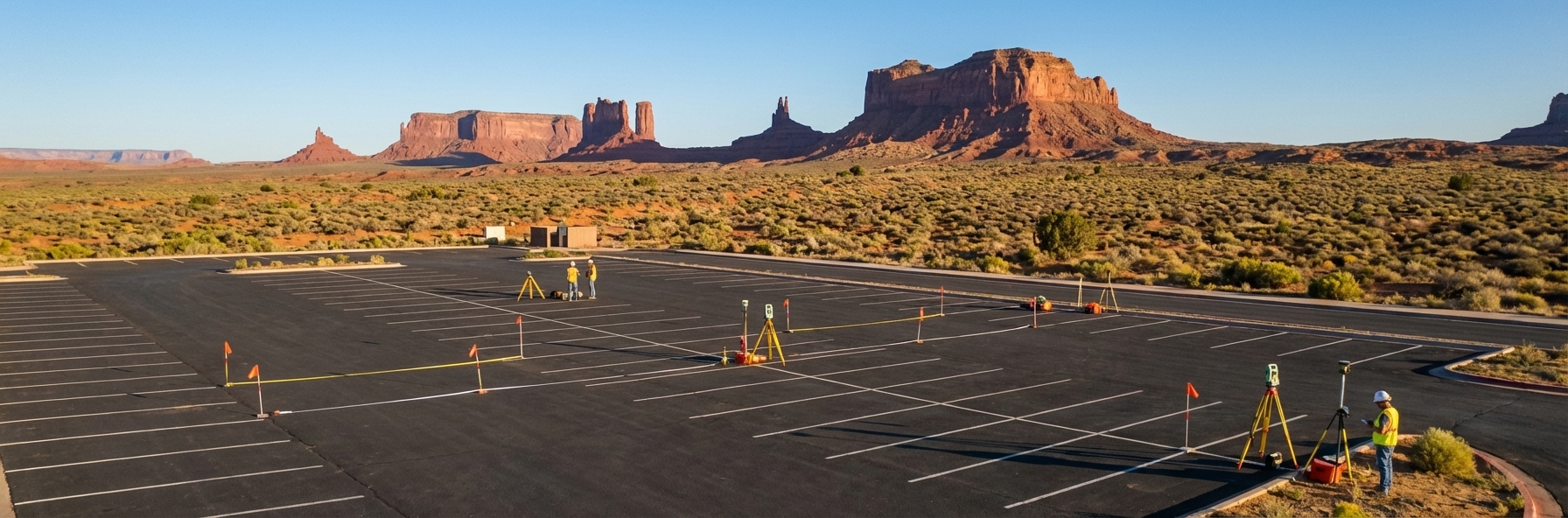
Site Selection for EV Charging Stations
Choosing the right location is the foundation of a successful EV charging installation. This lesson covers the key factors in site assessment.
Key Considerations
- Electrical capacity: Assessing existing electrical infrastructure and available power. A Level 2 EVSE at 7.2 kW requires a 40A dedicated circuit; a DCFC at 50 kW requires a 200A+ service upgrade in many cases.
- Accessibility: ADA/PROWAG compliance — accessible parking spaces must have an 8-foot adjacent access aisle and comply with surface grade requirements (max 2% in any direction). At least one accessible EVSE per facility is required for public chargers.
- Demand analysis: Understanding current and projected EV adoption in the service area. Plan for at least a 5-year adoption horizon when sizing service entrance capacity.
- Environmental factors: Weather protection, lighting, safety considerations. In the Mojave Desert, shade canopies are strongly recommended for both equipment longevity and user comfort.
Site Assessment Criteria — Quantitative Thresholds
Use this table to score candidate sites. A minimum threshold failure on any row requires corrective action or site re-evaluation before proceeding.
| Criterion | Minimum (Level 2 Only) | Preferred (L2 + DCFC) | Notes |
|---|---|---|---|
| Electrical service | 100A single-phase (Level 2 only) | 200A 3-phase | DCFC at 50 kW requires 200A+ service upgrade in most cases; verify with AHA-MACAV Power Service |
| Available panel capacity | 40A spare (one L2 circuit) | 100A+ spare or service upgrade | Each 7.2 kW L2 requires a 40A dedicated circuit (NEC 625.22) |
| Accessible parking (ADA/PROWAG) | 1 van-accessible stall with 8-ft access aisle | 1 accessible stall per 4 EVSE | Access aisle must be ADA-compliant: max 2% cross-slope in any direction; firm, stable surface to charger |
| Cable reach to charge port | 15 ft (L2 minimum) | 25 ft (L2); 10–12 ft (DCFC) | Measure from planned EVSE mount to vehicle charge port location at pull-forward position |
| Conduit run distance (panel to EVSE) | Under 200 ft | Under 100 ft | Longer runs require conductor upsizing for voltage drop; increases cost significantly |
| Shade / weather protection | Recommended | Required for DCFC | Mojave Desert: 110°F+ summers. Shade canopies are required for DCFC equipment longevity and user comfort. Factor into construction cost. |
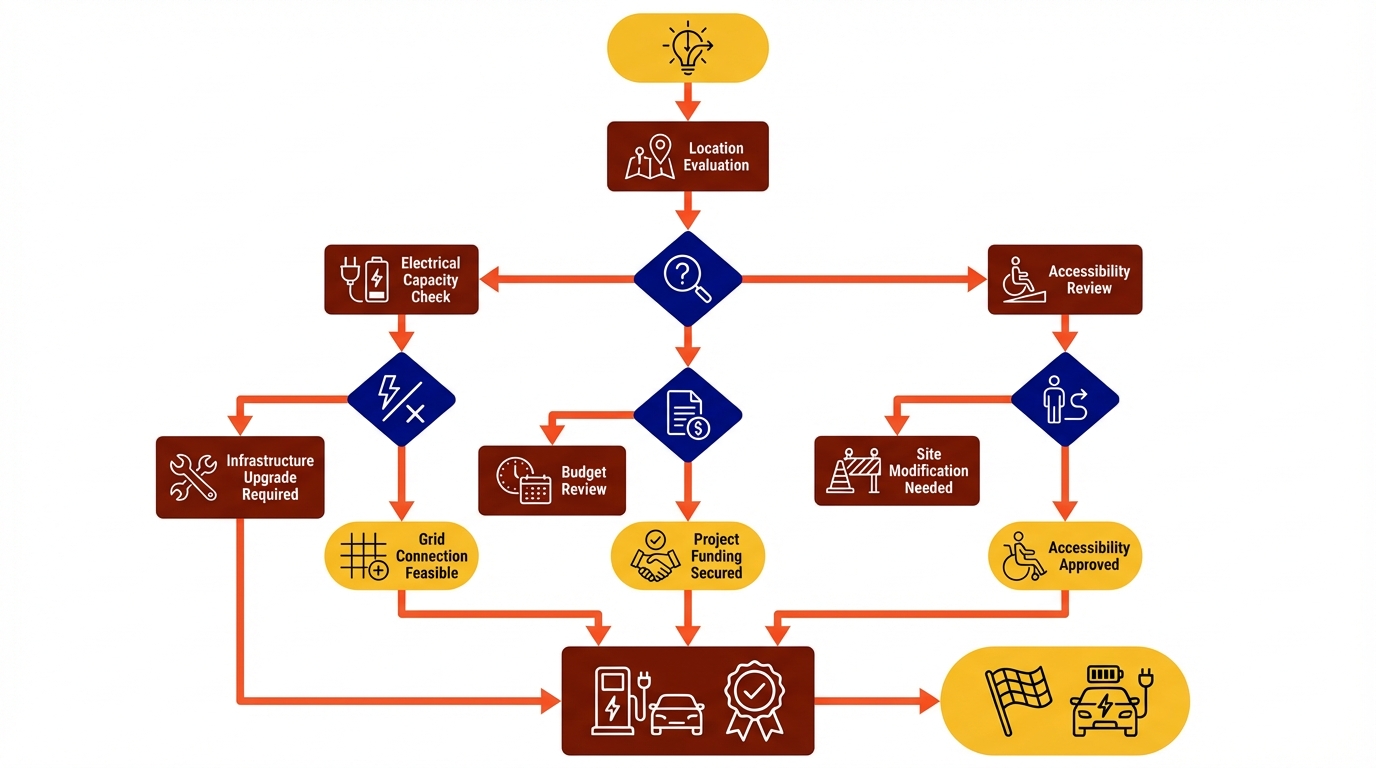
Site Assessment Procedure
ADA/PROWAG Compliance
At least one accessible EVSE parking space is required for public chargers. Key requirements:
- Stall dimensions: Accessible EV stall must be at least 8 feet wide with an adjacent 8-foot access aisle (van-accessible); 5-foot access aisle minimum for standard accessible stalls.
- Accessible route: An unobstructed accessible route must connect the EVSE to the building entrance — free of curbs, slope obstacles, or surface hazards. The cable must not cross the accessible route when in use.
- Surface grade: Maximum 2% slope in any direction within the accessible parking space and access aisle.
- Reach range: EVSE controls and connectors must be within accessible reach range: 15–48 inches above ground for a forward approach; 9–54 inches for a side approach (per ADA Standards for Accessible Design §308).
Tribal Land Site Selection — BIA Permit Process
Installing EV infrastructure on Fort Mojave trust land involves both tribal governance and federal agency coordination. The typical workflow:
- Tribal government approval: Submit project concept to Fort Mojave Indian Tribe's planning/energy office. This is the first gate — BIA will not process permits without tribal government endorsement.
- BIA permit application: Submit a Right-of-Way or Permit to Enter application to the BIA Colorado River Agency (Needles, CA office). Required for any construction that permanently modifies trust land. Typical timeline: 60–120 days for simple permits; 6–12 months for complex ROW.
- THPO review: The Tribal Historic Preservation Officer (THPO) reviews for cultural resource impacts. Submit concurrently with BIA application — do not wait. THPO review adds 2–6 weeks.
- Tribal building authority permits: Fort Mojave has its own building permit authority for construction on trust land. Obtain tribal building permit after BIA and THPO clearance.
- Utility coordination: Contact AHA-MACAV Power Service for service upgrade or interconnection application. Submit early — utility interconnection can take 4–8 weeks independent of BIA permitting.
Note: On fee land within or adjacent to Fort Mojave, county (San Bernardino or Mohave County, AZ) permits may apply instead. Confirm land status with the Tribe's legal office before submitting any permit.
Tribal EVSE Siting — Case Examples
Several tribal nations have successfully sited EVSE, providing useful precedent for Fort Mojave:
- Fort Mojave Indian Tribe (AMPS): Currently deploying EVSE under CEC ARV-25-015, including tribal facility charging sites across the Fort Mojave campus. First-hand BIA permit experience being developed through this program.
- Navajo Nation: Partnered with DOE and NEVI to install charging stations along US-491 and other corridors. Navigated BIA trust land permitting at scale; the Nation's energy division has published lessons learned accessible through DOE Indian Energy.
- Cherokee Nation (Oklahoma): Deployed Level 2 EVSE at tribal government buildings and health facilities starting 2022. Used DOE Indian Energy grant funding and BIA technical assistance. Model for tribal campus site selection prioritizing community member access.
Additional Site Selection Resources & References
AFDC Site Assessment Guide: The Alternative Fuels Data Center provides a comprehensive guide for evaluating EV charging site suitability, including load analysis worksheets and ADA compliance checklists.
Joint Office Tribal Technical Assistance: Free technical assistance is available for tribal nations through the Joint Office of Energy and Transportation — including on-site assessment support for tribal land EVSE projects.
NEC 625 Site Requirements: Review NEC Article 625 for electrical requirements that affect site selection — particularly service entrance sizing (625.22) and outdoor GFCI requirements (625.54) that may require additional electrical work at candidate sites.