
Installation Fundamentals
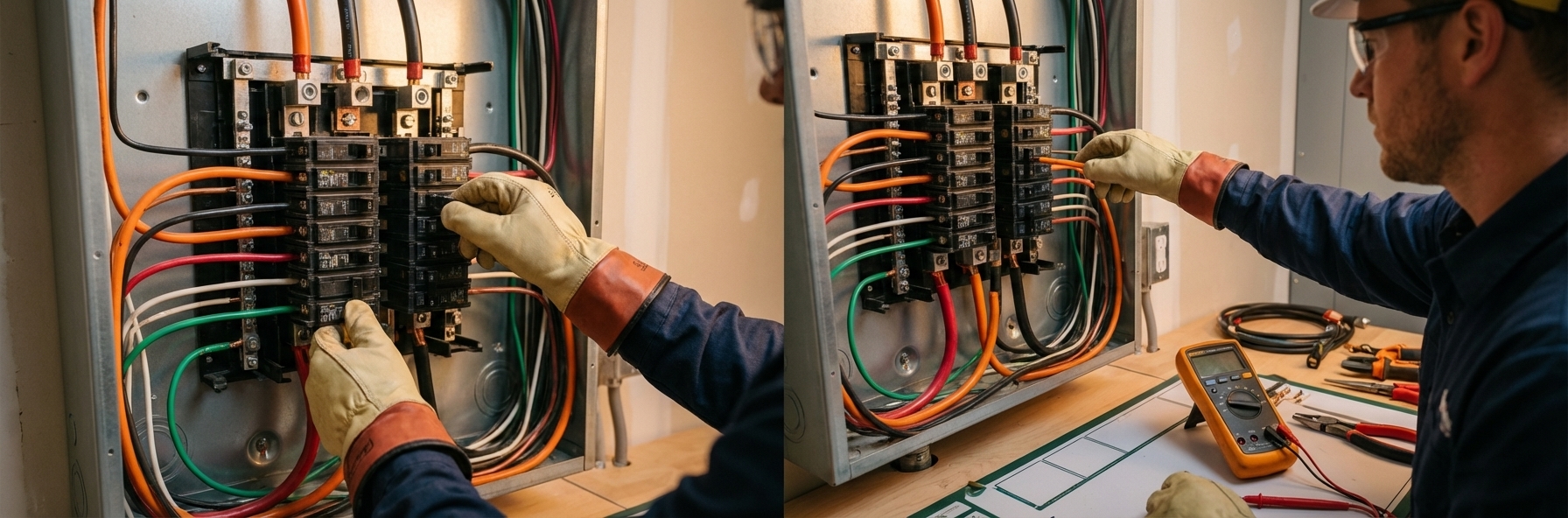
EVSE Installation Process
This lesson covers the step-by-step installation process for Level 2 and DC fast charging stations, with emphasis on NEC Article 625 code compliance — the foundation of EVITP certification.
NEC 625.22 — Branch Circuit Sizing (Critical for EVITP Exam)
EVSE is a continuous load — by definition, it draws current for 3 or more hours at a time. Under NEC 625.22, the branch circuit supplying EVSE must be rated at not less than 125% of the maximum continuous current draw of the EVSE.
Formula: Minimum circuit ampacity = EVSE rated amps × 1.25
| EVSE Output | Voltage | EVSE Amps | Min Circuit Amps (×1.25) | Conductor (AWG Cu) | Breaker |
|---|---|---|---|---|---|
| 3.8 kW | 240V | 16A | 20A | 12 AWG | 20A 2-pole |
| 7.2 kW | 240V | 30A | 37.5A → 40A* | 8 AWG | 40A 2-pole |
| 9.6 kW | 240V | 40A | 50A | 6 AWG | 50A 2-pole |
| 11.5 kW | 240V | 48A | 60A | 4 AWG | 60A 2-pole |
*When the calculation yields a non-standard breaker size, round up to the next standard size per NEC 240.6(A).
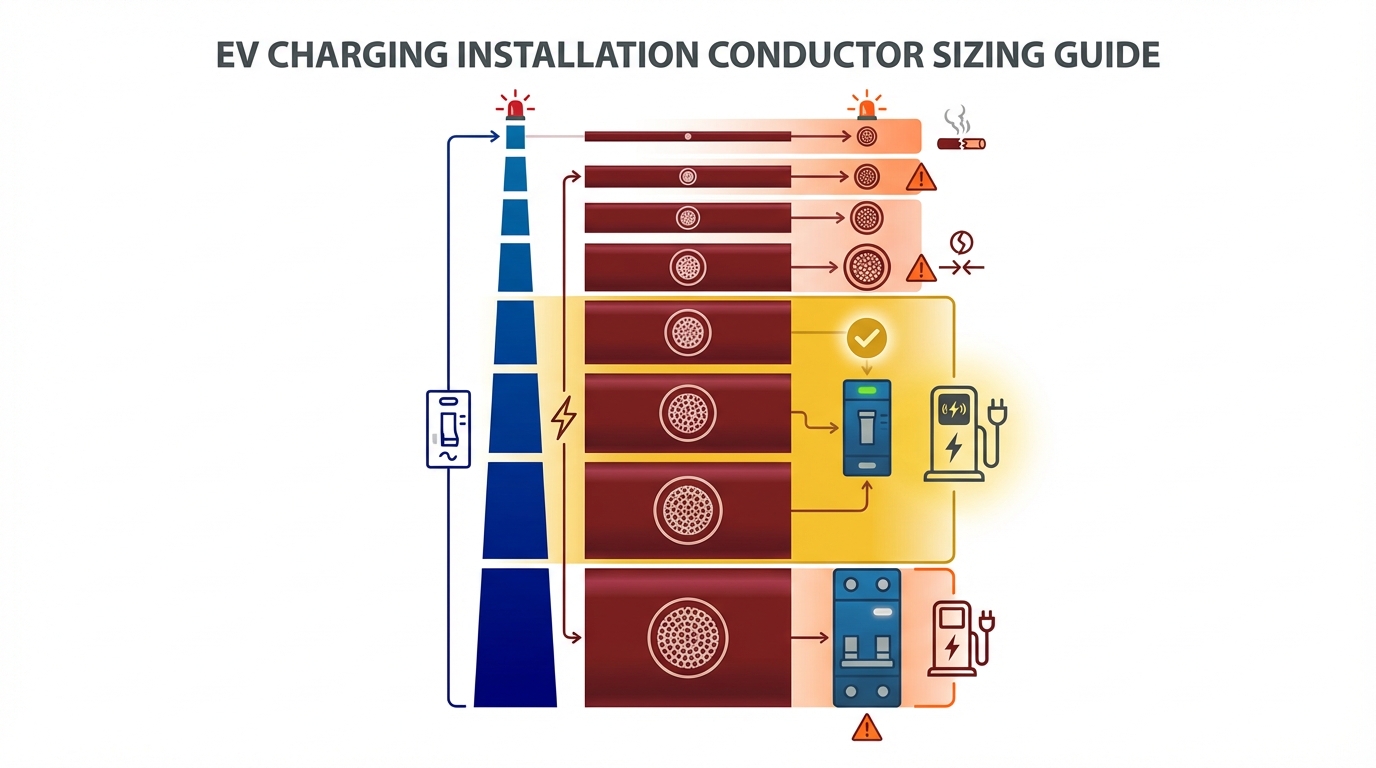
Worked Example: A commercial site installs a 7.2 kW Level 2 EVSE at 240V.
Step 1: Determine EVSE current: 7,200W ÷ 240V = 30A
Step 2: Apply 125% rule: 30A × 1.25 = 37.5A
Step 3: Select conductor: 37.5A requires minimum 40A-rated conductor → 8 AWG copper
Step 4: Select breaker: Next standard size at or above 37.5A → 40A double-pole breaker
Result: 8 AWG copper on 40A double-pole breaker, 240V circuit.
NEC 625.54 — GFCI Protection Requirements
NEC 625.54 requires GFCI protection for EVSE in locations where there is elevated shock risk:
- Outdoor EVSE: All receptacle-type EVSE outlets installed outdoors require GFCI protection.
- Garages and carports: EVSE in garages, carports, and areas accessible from the exterior require GFCI protection.
- Level 1 (125V 15A/20A) receptacles: All 125V convenience outlets used for EV charging require GFCI protection regardless of location.
- Permanently wired EVSE: For hardwired Level 2 EVSE, consult local amendments — many California jurisdictions require GFCI on all outdoor hardwired EVSE.
GFCI trip threshold: Standard GFCI trips at 4–6 milliamps (Class A). If an EVSE repeatedly trips GFCI, do not replace the GFCI — investigate for ground fault on the circuit or within the EVSE.
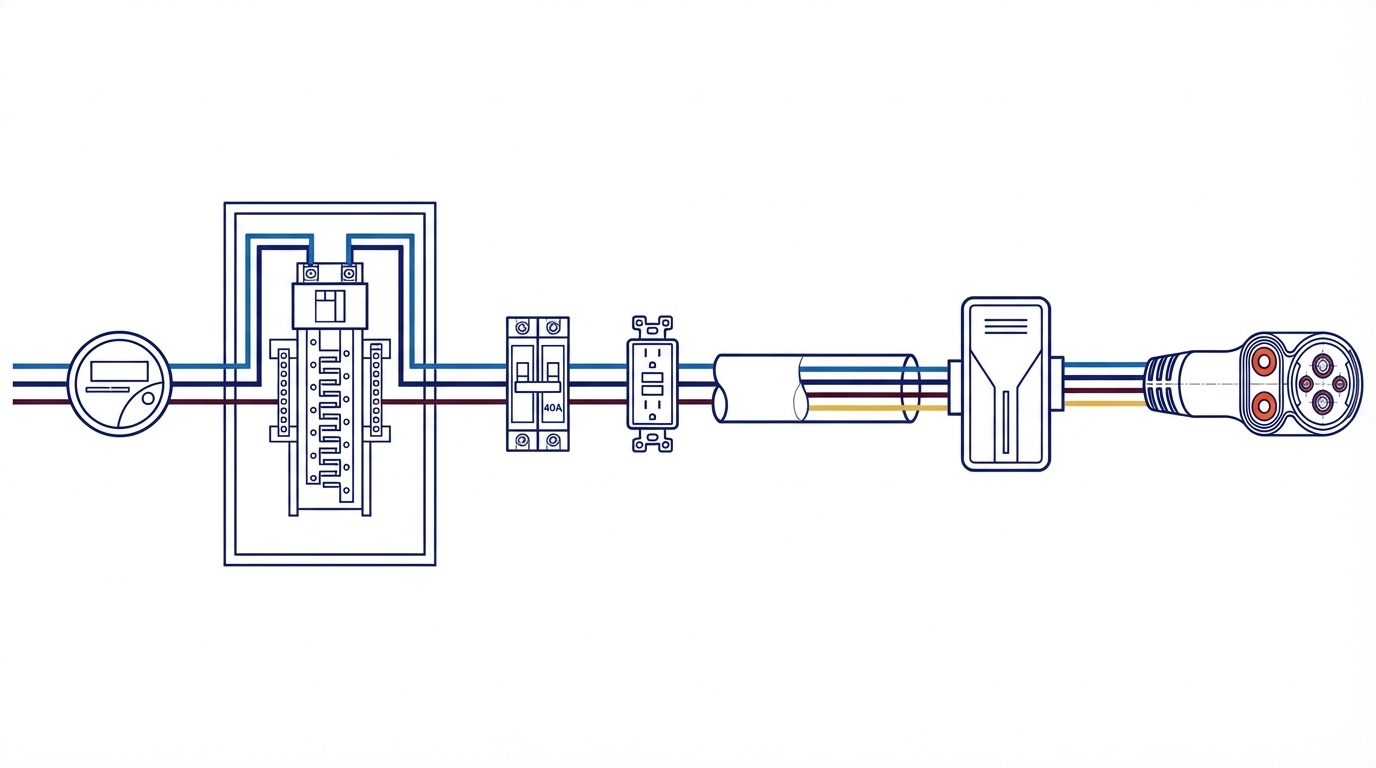
Overcurrent Protection
Overcurrent protection for EVSE branch circuits must:
- Be rated at 125% of EVSE ampere rating for continuous loads (matching the conductor sizing requirement)
- Not exceed the ampacity of the branch circuit conductors
- Be a dedicated circuit — no other loads may share the EVSE branch circuit
- For 240V Level 2: use double-pole circuit breaker (both legs protected)
Pre-Installation Checklist
- Permits and inspections coordination — obtain before work begins
- Utility interconnection application (AHA-MACAV Power Service) — submit early, can take 2–6 weeks
- Equipment procurement and staging — verify equipment is EVITP-eligible and CEC-listed
- Safety plan and PPE requirements — arc flash calculation for panel work, rubber gloves for GFCI testing
Commissioning Sequence
NEC Article 625 Quick Reference
625.22 — Branch Circuit Sizing: Circuits must be rated at not less than 125% of the maximum continuous current draw of the EVSE. All EVSE are continuous loads by definition.
625.54 — GFCI Protection: Required for outdoor EVSE, garages, carports, and areas accessible from the exterior. Standard GFCI trips at 4–6 mA (Class A).
625.44 — Equipment Connection: Covers cord-and-plug vs. hardwired connection requirements.
240.6(A) — Standard Breaker Sizes: When calculations yield non-standard amperage, round up to next standard size: 15, 20, 25, 30, 35, 40, 45, 50, 60, 70, 80, 90, 100A.